




Eight Promo Mechanics, One Language: How We Kept the BoxBet iGaming Ecosystem From Falling Apart




This article is part of the Flatstudio × BoxBet case study. BoxBet is a crypto iGaming platform with eight promo mechanics inside a unified design system. CEO of BoxBet — Christian. For marketers, designers, and product teams creating advertising materials for iGaming and adjacent niches. Main article of the series — here.
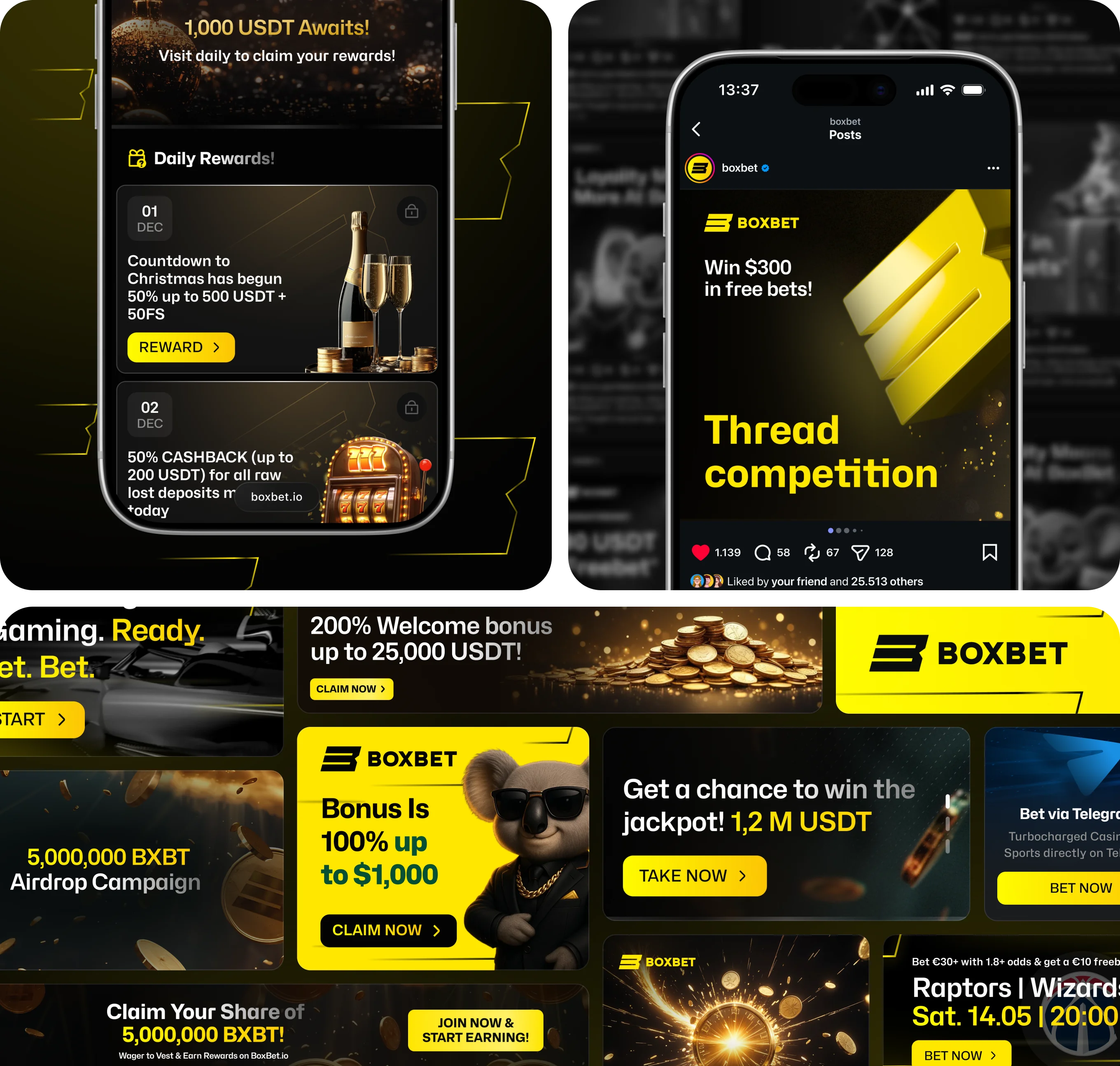
An iGaming platform isn't one product. It's dozens of touchpoints, each of which can speak its own language. The jackpot looks one way, bonuses look another, streamer banners look like a third. And as the team grows and the client adds new markets and channels, that drift becomes harder to ignore.
At BoxBet we built eight separate promo mechanics. The goal was one: make them all look like parts of the same system — not like different contractors from different countries.
The Team
Graphics and promo materials were led by Masha Solovieva together with Yulia Sadzhevilina. Olena Buzila helped them. Interface solutions for the promo sections were designed by Roman Daneliyuk. Art direction — on me.
The complexity here isn't the number of people. It's that different tasks came in at different times from different directions: the client kept adding new tests on new platforms, new markets, new formats. The system had to hold up under that without losing coherence.
Eight Mechanics
Each BoxBet promo mechanic is a separate interface section with its own logic, its own interaction scenario, and its own communication.
- Jackpot — three progressive levels: Rare (30–50 USDT), Epic (100–300 USDT), Prime (from 445,000 USDT). Each level has its own minimum bet and its own hit range. Visually this is the most dramatic section: gold coins, dark background, big numbers.
- Lottery — a monthly cycle with a prize pool up to 5,000 USDT + 600 free spins. Players earn tickets with deposits: 1 ticket per 30 USDT, 2 per 50 USDT, and so on. The design is restrained — prize table, timer, button.
- VIP Program — eight levels: from No Level to God Mode. Each level has its own Lucky image (we generated the mascot's outfits in Sora, with Nano Banana, one per level), its own cashback, and its own free spin conditions. This is where the mascot and the design system meet most directly (more on that — in Article 2).
- Bonuses — Welcome Package 200% up to 25,000 USDT, Wednesday Free Spins up to 120 free spins, Drops & Wins Slots, Freebet. Four active bonuses simultaneously, each with its own conditions.
- Referral Program — 1,500 USDT per referral + up to 30% commission. At the time of design: over 120,000 referrals, payouts exceeding 4,000,000. The section includes a detailed unlock and commission calculation table.
- Airdrop — 5,000,000 BXBT tokens distributed via a betting leaderboard. Countdown timer, fixed position while scrolling so the user always sees their rank. Roman designed a dedicated "fixed user position while scrolling" state — a detail most platforms ignore.
- Advent Calendar — daily rewards from December 1 to 25. A player opens a cell and gets a bonus: free spins, cashback, deposit bonus. Bigger bonuses on days 7, 14, and 21. It's a seasonal mechanic, but it required a full interface solution and its own design approach. All the graphics for this page were generated too — there wasn't much time, but there were a lot of ideas that needed to be visualized and chosen together with the client's team.
- Tournaments — regular competitions with a leaderboard and prize pool. A format found on most platforms, but here it had to match the same language as everything else.
External Campaigns
Alongside the interface mechanics, we were running external promo on several platforms simultaneously.
- Etherscan — 18 banner variants plus A/B tests. The audience there is specific: crypto-native users who know what a smart contract is. Banners had to be clean and not look like stock casino ads.
- Indian market — paid ad placements on niche platforms. India is maximum visual noise. To keep the banner from getting lost, we made it recognizable through bold contrast and the brand's yellow. No "quiet" communication.
- Bitcointalk ANN thread — one vertical graphic that tells the project's story in BoxBet's visual style. A format where you get one shot.
- Airdrops.io, frontpage, jumbo — banner campaigns with animation where it made sense. Different audience everywhere, same color language.
- Twitch and YouTube streamers — 1200×100 banners in three styles: dark, yellow, white — with and without the koala. The client could choose based on the streamer's aesthetic.
- TON App — app screenshots placed in the Telegram app directory. At once promo and product presentation.
The Sports Failure
There was a part of the work that didn't go as planned.
We designed the sports section — interface solutions, promo mechanics for betting, corresponding graphics. It took time. But the client couldn't build the sports section in the form they'd envisioned. The technical implementation turned out to be more complex and time-consuming than the time left before launch allowed.
They had to buy SoftSwiss and integrate everything onto it. SoftSwiss is very limited from a customization standpoint — far less room for design decisions than a custom build.
Part of the work didn't make it into the product in the form it was designed. That's expensive in both team effort and resources. But it's the reality of iGaming products: technical constraints shape design decisions, not the other way around.
What Held Everything Together
The main answer — the brandbook and the mascot. When Yulia was making a banner for Etherscan and Dima was simultaneously working on the Advent Calendar, Roma on the VIP program page with its levels, they all knew: dark background — yellow banner, light — black. Typography — Hubot Sans. Angle — 15°. Lucky — a specific version with a specific mood for a specific context.
The same rules for everyone. That's why eight different mechanics look like one platform.
The Client, Templates, and Independence
Christian highlighted three things specifically. The first — the Advent Calendar. He called it the best mechanic of the series. It genuinely looked like a considered product, not "another bonus section."
The second — banners in a GTA 6 aesthetic. We made several variants where we kept BoxBet's language but brought in techniques from GTA 6's visual culture — specific lighting, composition, feeling. The client saw it and said that was exactly what he'd wanted: recognizable, but fresh.
The third, and possibly most important — templatization. We built a system where the client's team can change banner copy themselves, choose between three color schemes, and decide whether there's a koala or not. Without involving Flatstudio for every minor change.
That's our approach in the Marketing Design & Assets service: a tool in the client's hands, not a dependency on a contractor.
Eight Mechanics — One Language
The fact that Jackpot, Lottery, VIP, Referral, Airdrop, Bonuses, Advent Calendar, and Tournaments look like a single platform — that's the result of a system established in the identity (Article 1) and given a face through the mascot (Article 2).
How that system lives at the level of code and components — in Article 4.

.png)
