





Lucky the Koala: How We Created a Mascot That Plays 8 Different Roles




This article is part of the Flatstudio × BoxBet case study. BoxBet is a crypto iGaming platform with its own BXBT token and a VIP program for players. CEO of BoxBet — Christian. For designers, art directors, and product teams building mascots and character systems. Main article of the series — here.
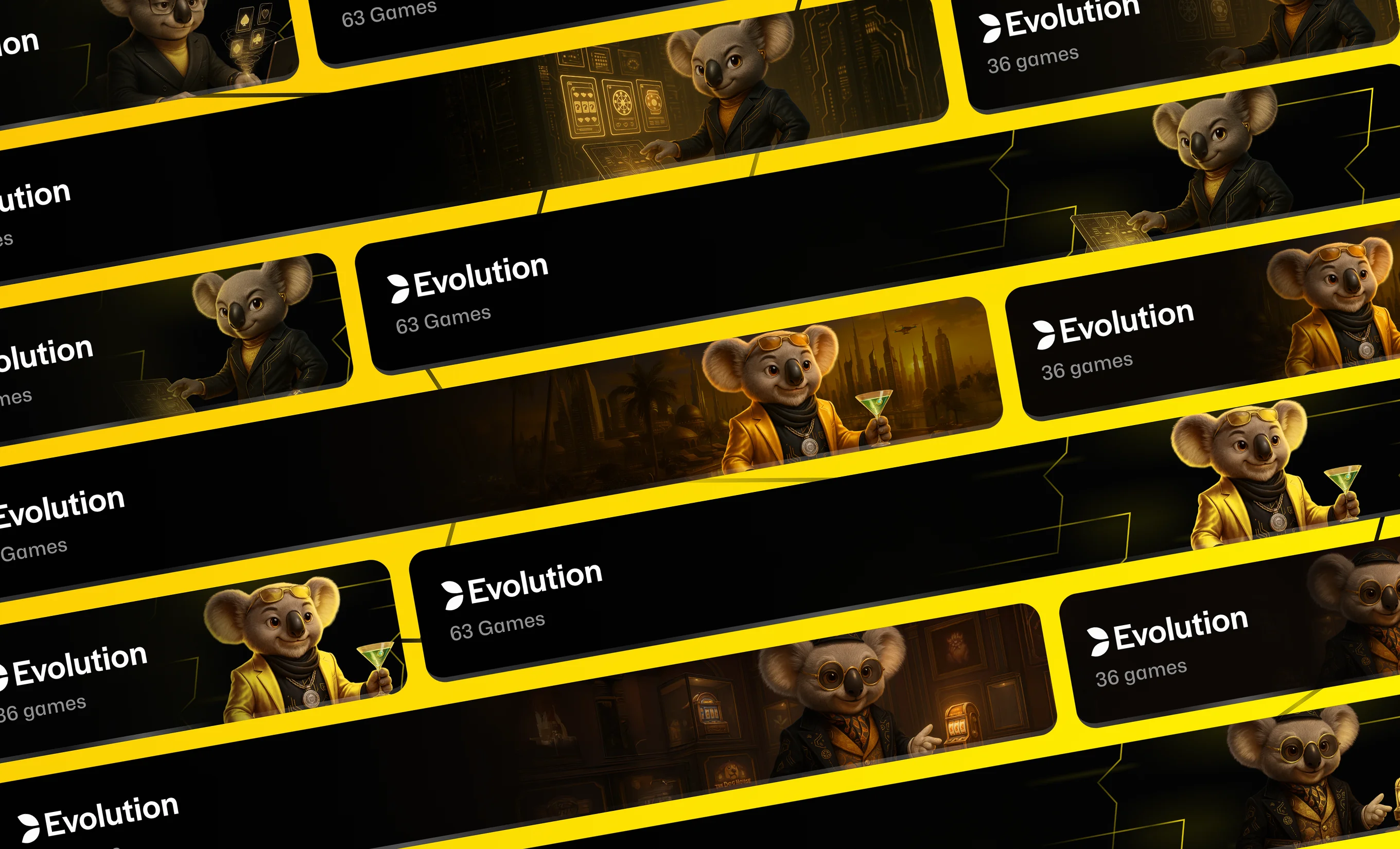
Once a brand has its identity — logo, color, typography — the next question becomes inevitable: who speaks on the brand's behalf? At BoxBet, that "someone" turned out to be a koala named Lucky.
But before he appeared in his final form, we went through a failed first version, an unstable AI tool, and client feedback straight out of a Hollywood movie.
Why a Koala at All
We asked ourselves this question inside the team. BoxBet is a platform built around the McLaren W1 as a reference point. Speed, precision, technology. A koala reads as the opposite: slow, fluffy, relaxed.
But that was exactly the logic. An iGaming mascot doesn't need to be yet another aggressive character with fists up or sharpened teeth. There are already too many of those. Lucky was meant to be the one who doesn't need to shout to be noticed. He's confident. He's already won — so he's relaxed.
The paradox worked. The client agreed once he saw the first concepts.
Dmytro Staryshev and the Tool Selection
The character was developed by Dmytro Staryshev. The process started on November 7, 2025.
Dmytro began with Midjourney — to explore stylistic direction. The chaos parameter in Midjourney ranges from 0 to 100: the higher the value, the more unpredictable and varied the output. We explored the full range to figure out what aesthetic actually suited this character.
Once the style was defined — 3D, photorealistic soft rendering with sharp illustrative clarity — the main work moved to Sora by OpenAI. About 90% of the final character is Sora. The tool was new and unstable at the time, but it delivered exactly the level of quality we needed.
Costumes and outfit variations came from Nano Banana. Also a new tool at that point. Also unstable.
The First Version Didn't Make It
The original idea was simple: a young, energetic koala. Dynamic. Made for a young audience.
The client looked at it and said: not right. "This is a platform where real money is on the line. The character needs to look like he's been through something. Not a newcomer."
We had to restart the core personality. Lucky aged. Not literally — he remained a stylized character — but his appearance and behavior shifted toward a grown-up "degen." Someone who understands risk and still walks into the game. Calmly.
The client gave us a precise reference point: "Looks great! Let's make him more self-assured — like Reuben from Ocean's Eleven."
If you've seen Ocean's Eleven, you know Reuben: bold clothes, big glasses, a cigar. Always one step ahead, always with a hand on the pulse. That's exactly what we were going for.
The Racing Suit and the Limits of AI
One of the most complex elements was the racing suit. Yellow, with black side panels, knee guards with yellow trim, and sneakers in the same color scheme. Detailed. Precise. Consistent with the McLaren aesthetic we established back in the identity work (more on that in Article 1).
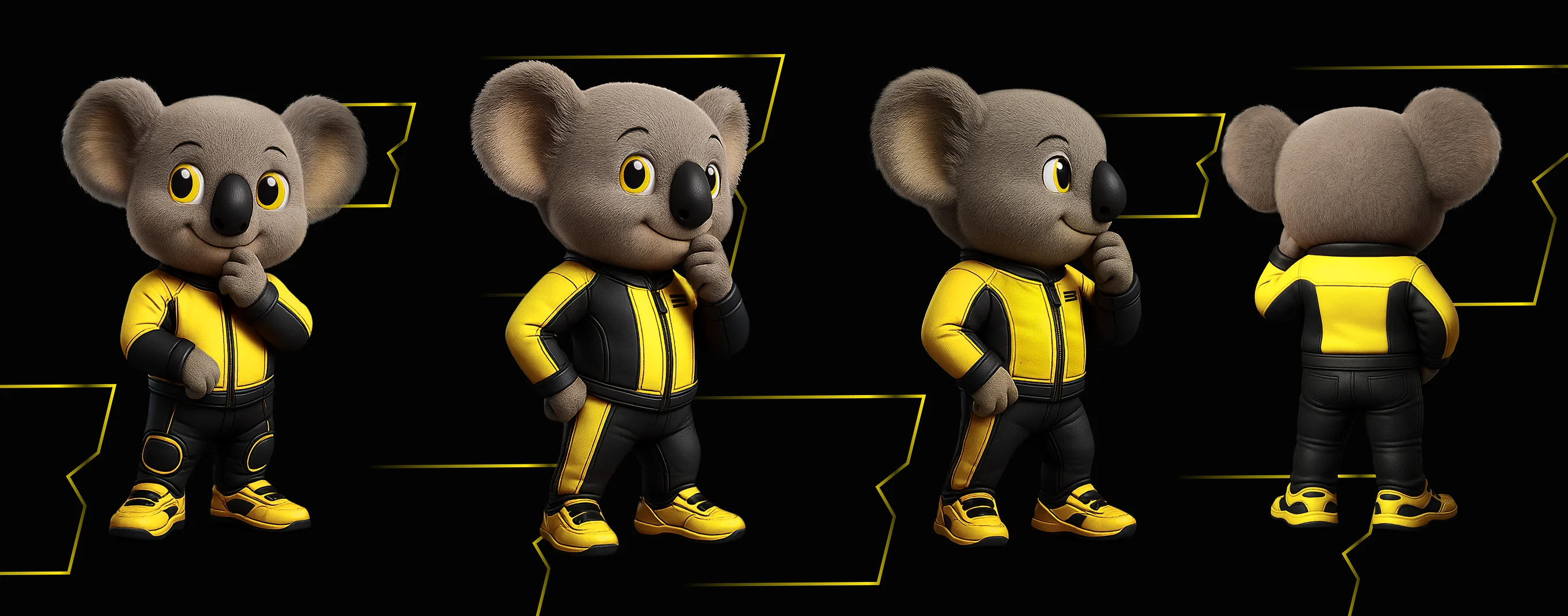
The problem with AI generation is this: the more detailed the prompt, the less predictable the result — and I'm talking specifically about when these tools were just launching. It's not intuitive, but that's how they worked. We wrote precise specifications: outsole color, shape of patches, seam placement. Sora and Nano Banana responded with chaos. But the more we learned to work with these tools, the better our results got.
With Nano Banana, we'd get an acceptable result roughly once every ten attempts. The rest came back with distorted proportions, disappearing details, or a completely different design from the one we specified. Nano Banana 2 is a different level entirely — there are almost no errors now, or we can't find them. We generated two full football teams with no problems in under five days, including kits — there's a separate article and case study coming on that, but for now let's get back to this one.
We learned to balance: enough detail to preserve the style, but not so much that the model goes off the rails.
From Character to System
The final Lucky is a set that covers specific product needs.

Five facial expressions: Welcoming, Victory, Confident, Casual, Energetic. Each one for its own context. Welcoming — on the registration page. Victory — after a win. Energetic — in promo banners.
Eight variants for the VIP program. Each level got its own version of Lucky — different outfit, different detail, different state. Each level is a self-contained image. A visually readable hierarchy that players understand without any explanation.
A 360° view. This is a baseline requirement for any mascot intended for use across multiple formats. We needed to know how he looks from behind and from the side — especially for animated versions and 3D applications. A year ago that kind of capability didn't exist the way it does now — dropping in an image and building a 3D model in one click, rotating it on the fly. How fast everything is changing.
Animated versions for social media and in-platform mechanics came after the main approval. The client accepted Lucky on November 29, 2025, but work on new poses continued — for Twitter, for partner materials, for the banner system.
Where Lucky Lives
The mascot is built into the product.
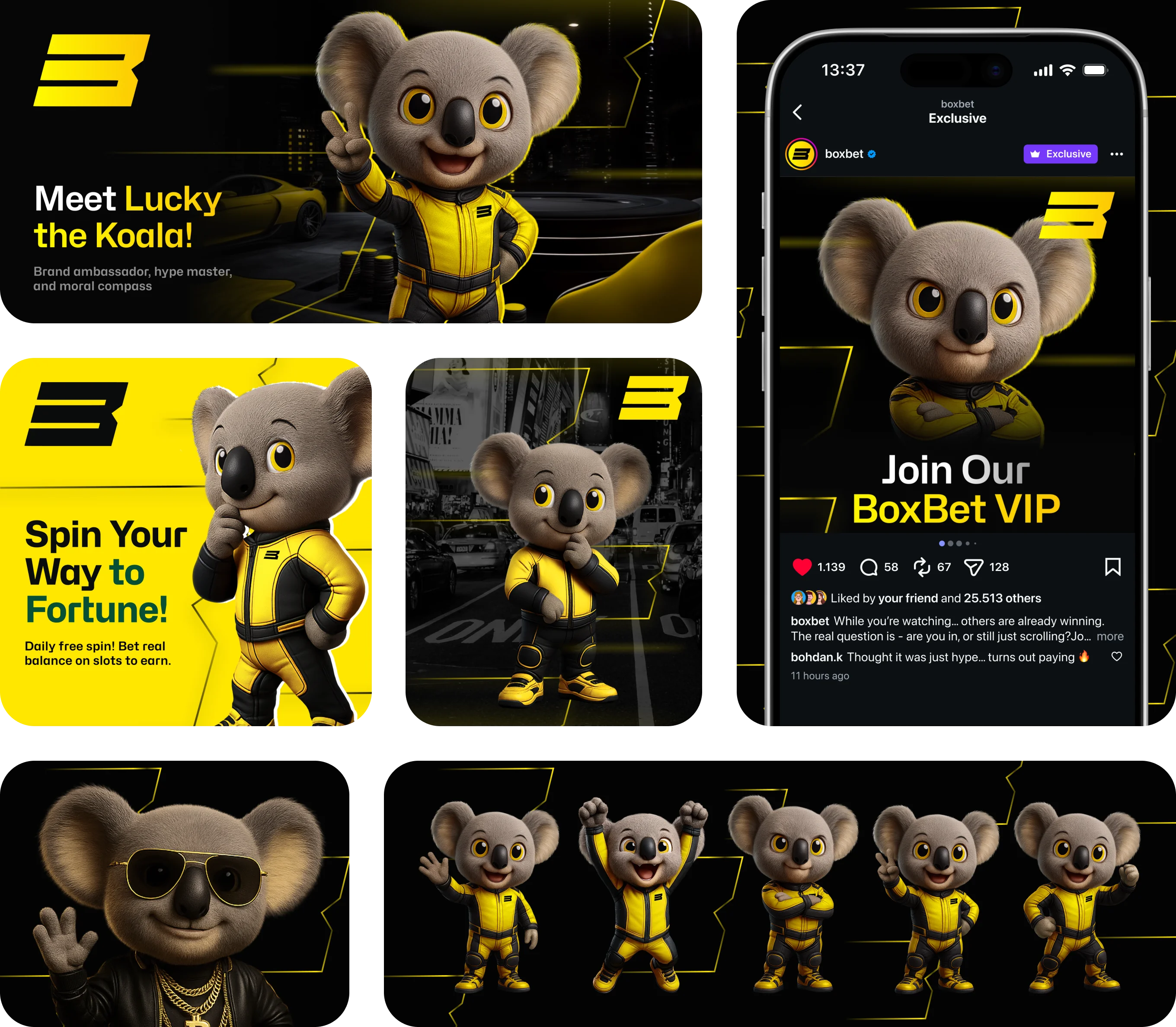
On BoxBet and partner affiliate sites, Lucky appears in banners — the same ones where a dark interface always gets a yellow banner, and a light one gets black. The color logic we built for the entire banner system applies to him too. It keeps the character recognizable regardless of the background.

In the VIP program, he serves as a progress indicator. Players see what level they're at through a specific Lucky image — not just an abstract icon, number, or label.
On social media — through animated and static posts — he becomes the face of the brand's communication.
A Final Note
Sora no longer exists in the form we worked with. OpenAI shut down public access recently. Dmytro managed to squeeze everything he needed out of the tool — and a little more.
Sometimes that's how it goes: you use a tool inside a narrow window between "still unstable" and "no longer available."
What's Next
Lucky is part of a larger system. The fact that a single character covers eight VIP levels, five emotional states, and multiple product scenarios simultaneously — that's the result of how we built the promo mechanics and design system for BoxBet as a whole.
How those mechanics hold together — in Article 3. How the design system gives them structure — in Article 4.


.png)
